Feb 20 2011

Manic Street Preachers

(Originally published in The Japan Times)


Manic Street Preachers’ angry tunes turn up Japanese fans

By Fred Varcoe

To some, the Manic Street Preachers are the new Sex Pistols, the new Guns N’ Roses, the new Nirvana, the British Guns N’ Roses, the British Nirvana, etc., etc.
You get the idea.
Whoever they are – and they will insist, no doubt, that they are merely the Manic Street Preachers – there always remains the danger that this week’s new wild boys could turn into New Punks On The Block.
One of the horrors of old age (35.96 years) is that you keep telling yourself, “That’s been done before.” Of course, my parents tried to say this, but lacked the conviction of actually knowing what had gone before. In fact, they were hoping that nothing like (insert horror of your particular generation here) had ever happened and merely thought that if I thought something wasn’t original I would lose interest in it.
In reality, of course, if what had gone before was so horrendous as to unsettle my parents, then I certainly wanted some of it as part of my antisocial weaponry. As a result, my parents were convinced in the ’70s that I was: 1) worshipping the Devil (Black Sabbath); 2) taking acid trips to Katmandu (Syd Barrett and Pink Floyd); and 3) killing off prominent members of the establishment (the Clash and Sex Pistols).
Little did they know that I was secretly conforming to their social values – well, I was closer than they thought – and that, far from worshipping the Devil, we were actually fairly good mates.
The Manic Street Preachers, like most bands, are doubtless not interested in comparisons to what’s gone before. Straight musical comparisons of the type “The Beatles are better than the Stones” or “The Jam is better than the Who” rarely do more than irritate musicians. Still, the past is an important point of reference and, as music is an evolutionary art, it has significance.
The band’s ironic allusion to the past in “Condemned to Rock ‘n’ Roll” makes the point that we’re talking about an indefinite now rather than a series of generational crises:
“The past is so beautiful
The future like a corpse in snow
I think it’s all the f—ing same
It’s a life sentence babe.”

The Preachers have been shot out of the same gun that produced the angry sounds and sneers of bands like the Clash and the Sex Pistols. (On Fuji TV’s “Beat U.K.” recently, lead singer/guitarist James Dean (groan) Bradfield tried to impress the viewers with a couple of “f— you’s” while bassist Nicky Wire did his best Sid Vicious impersonation and came across as being genuinely thick.)
Perhaps significantly, they too have risen to the fore in a deep economic recession. The bleak prospects facing the young and unemployed of Britain have given rise to a new breed of angry young musicians and, just as important, a new breed of angry young fans.
As punk was a welcome antidote to the disco dross of the ’70s, so the new breed of the ’90s is welcome relief from the neo-hippy dirges of the Manchester scene.
That the Manic Street Preachers arc the most exciting band to come out of Britain in recent years is hardly surprising. They are virtually the only exciting band to come out of Britain in recent years.
The band’s Japanese debut at Club Citta on May 11-13 was sold out weeks ago and could easily have stretched beyond a week. After Nirvana’s Japanese tour earlier this year, it was the most eagerly awaited rock event of 1992. But unlike Nirvana, the Preachers went some way to delivering live what they promised on their debut album, “Generation Terrorists.”
The main difference was balance. The songs on the album, while leaving no doubt we are dealing with anger, were presented with a slightly sugar-coated production job. Live, the energy level hits the high end of the scale as 1,000 sweaty Japanese punks and rockers bounce up and down to the Preachers’ very direct brand of rock ‘n’ roll.
Where Nirvana is slightly flakey and occasionally laid back in delivering the message and the music, the Preachers slam it into your face. The guitars of Bradfield and the slightly – okay, let’s be honest, very – redundant Richey James grind along like a rivet gun, laying down a foundation for Bradfield’s excellent and, unlike Johnny Rotten’s or Joe Strummer’s, controlled vocals.
If you can’t tell how angry Bradfield is just by looking at him (believe me, you can), you can take a peek at the lyrics that accompany the CD.
“Madonna drinks Coke and so you do too
Tastes real good not like a sweet poison should
Too much comfort to get decadent
Politics here’s death and God is safer sex”
(“Slash and Burn”).
Or:
“Useless generation
Dumb flag scum
Repeat after me
F— Queen and country
Repeat after me
Imitation demi gods
Repeat after me
Dumb flag scum”
(“Repeat (U.K.)”).
The Japanese fans may understand the album title, but probably don’t make much headway with the semi-literate lyrics. The important thing is the gist of the message gets across. With the concert being held in the all-standing human crush heat of Club Citta, there is an intensity there that is usually lacking at theater venues.
Added to which, the Preachers’ penchant for choral-style hooks allows the Japanese audience to actively participate and get closer to the band and the music. A few adventurous fans climb over the shoulders of the mob down front and threaten to get on stage, but always back out at the last minute, much to the disappointment of the fans and the band, who are hoping that the barrier between the two will break down. But this is Japan, so it won’t.
Still, as events in the metropolis go, it made its mark. The band has the same universal appeal as Guns N’ Roses and Nirvana, and, like the Seattle rockers, it has just taken the first big step. Fame and money are on their way. Providing Bradfield keeps his muse (with five more years of a Conservative government, this should be no problem), the future looks bright. Next time round, the Manic Street Preachers could be playing the Budokan.
Except there may not be a next time round if the band members are to be believed. They have said they will break up rather than outlive their usefulness. They don’t want to end up as memorial pieces.
A wise move. Otherwise we could be looking at a fate worse than death: the new Sham 69.

Feb 13 2011

Gary Moore

Review of Gary Moore, originally written for The Japan Times

Concert shows more of Moore can only be better

Guitarist Gary Moore’s blues-rock talent shines at Nakano Sun Plaza

By FRED VARCOE

Somebody’s judgment must be wrong.

Last year, Yngwie Malmsteen played the Budokan; last week Gary Moore played Nakano Sun Plaza. Malmsteen is a technically brilliant guitarist with all the musical feeling of a cardboard box and a face that girls would die for (and when they hear his music, they no doubt frequently do).

Moore, on the other hand, looks like he’s been visited by a particularly nasty biblical curse, but plays and sings as if touched by the hand of God.

Moore may be slightly less than megabig in Japan, but he is recognized in Europe as one of rock’s premier guitarists and as a strong singer and powerful songwriter.

But he took some time finding both success, in commercial terms, and a firm musical direction. He first emerged with Skid Row — no relation to the new U.S. band of the same name, which was unaware of the duplication — back in the early ’70s, before moving on to the heavy power-jazz of drummer Jon Hiseman’s band Coliseum II.

Moore gained wider fame when he joined fellow Irishman Phil Lynott in Thin Lizzy for a short spell in 1973 after the departure of Eric Bell and again in 1978, before being fired a little more than a year later for missing two gigs on a U.S. tour.

Nevertheless he formed a fruitful, if not productive, partnership with Lynott that resulted in Moore achieving chart success for the first time with “Parisienne Walkways,” from his patchy 1978 debut album “Back on the Streets.”

There is no doubt the partnership could have gone on to greater things, but Lynott finally overabused himself and croaked in 1986.

By then, Moore had half a dozen albums in the racks, a firm reputation as a guitarist and performer and enough strong songs to make up a strong set.

And a strong set is what he served up at Nakano Sun Plaza. Opening with the title track from his new album “After the War,” Moore comes across as aggressive, but as the crowd responds — the Sun Plaza does at least have the advantage of being intimate — a smile creases his already well-creased face.

Barely had the chunky riffs of “After the War” started to fade when Moore crunched into the old Yardbirds’ hit “Shapes of Things.” The original was powerful enough, but Moore’s version — even on the “Victims of the Future” album — is simply devastating. Riffs crash down all around, colored by slick overlays and a scorching lead with a creditable lead vocal from keyboard player/guitarist Neil Carter. As good a version of a hard-rock song as you’ll find.

But although Moore’s blues-rock virtuosity reeks of venom, he has a gentler side to his musical soul, and on the instrumental “So Far Away,” accompanied only by Neil Carter’s synthesizer, he showed the power of the sustained note as the Sun Plaza glowed to the sound of Moore’s Les Paul in a way that perhaps only Carlos Santana has ever equaled.

Another strong characteristic in Moore’s singing, playing and songwriting is his ability to blend Irish folk music influences into his naturally hard-edged style without ever compromising on power.

Indeed, the passion Moore derives from his homeland is evident on so many of his songs, and those musicians whose passion fires their music invariably have a head start over the likes of Yngwie Malmsteem and the cardboard box set.

On numbers such as “Blood of Emeralds” (“all about Ireland”) from the new album; the acoustic “Johnny Boy”; and the main set’s final number, “Over the Hills and Far Away,” with its beautiful, warm emotional hook, Moore fired up himself and his fans and demonstrated a degree of intensity sadly lacking in so much of today’s soulless hard rock.

Moore encored first with two rockers — “Rockin’ Every Night” and “All Messed Up” — before coming back for “Johnny Boy” and the divine “Parisienne Walkways” with his solos lit up by laser-intense sustain and lightning flashes of speed.

If quality determined the size of hall an artist played, then Gary Moore should be playing the Tokyo Dome and Yngwie Malmsteen should be playing the men’s room at Shibuya Station. Somebody’s judgment must be wrong, but it wasn’t that of the 2,000 or so people at Nakano Sun Plaza.

I guess it must be Yngwie’s.


Jan 19 2011

Out with the old

From www.photomichaelwolf.com

Text from Kyoto Journal 55

(A stunning little piece. It could equally apply to other places [I was thinking Korea]. Enjoy.)

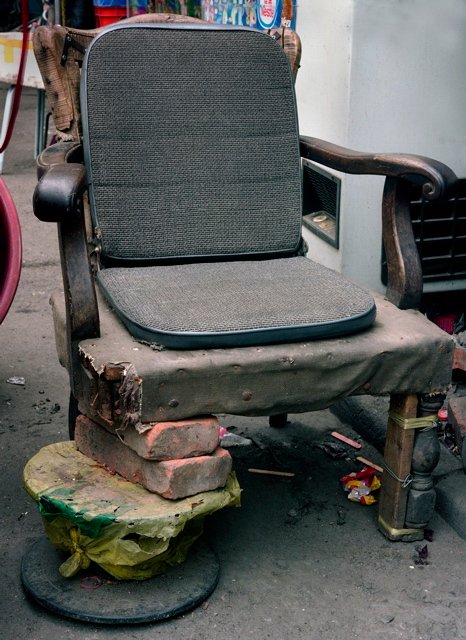
“On one of my walks through Beijing, I discovered the chair shown on the previous page. It stood in front of a small shop where one could buy, amongst other things, delicious dumplings and soy milk. The shop owner, a young, rather fat man, was sitting on the chair as if it were a throne. And what a wonderful chair it was, propped up on one side by an old spingle and two bricks, and on the other its weak leg was splinted with a piece of wood and some plastic string.

“I set up my camera and tripod and proceeded to take some photographs. As so often when I work in China, a large crowd of people gathered behind me and bombarded me with questions. ‘Why are you taking photographs of that chair; it’s so ugly’ people asked me. `You are making fun of China,’ an older woman hissed as she held her hand in front of my lens. I turned to her and explained: ‘This is an old chair which has had a long and hard life. When I look at it, I do not see an ugly chair. I see a chair with a strong character, like a person who has lived for 80 years and has not given up the will to live even though life has been hard.’ The woman looked at me and shook her head: `I don’t believe you. You are a foreigner who is trying to show how backward the Chinese are. Why don’t you take a picture of a new chair?’

“I finished taking the portrait of the chair, packed up my equipment and walked on. Later that day, I walked by the shop again in order to have another look at the chair. It was gone. When I asked the owner where it was, he said: ‘After you left, the public security police came and smashed it into 100 pieces. They said it was shameful for China and that I should buy a new one.’ ”

(Thanks to Michael Wolf for permission to run this.)


Jan 18 2011

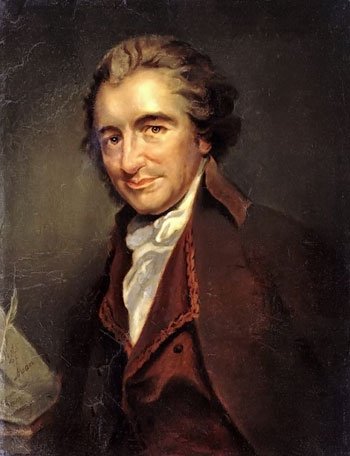
Religious thought for the day (every day): Thomas Paine

I believe in one God, and no more; and I hope for happiness beyond this life.
I believe in the equality of man; and I believe that religious duties consist in doing justice, loving mercy, and endeavoring to make our fellow-creatures happy.
But, lest it should be supposed that I believe in many other things in addition to these, I shall, in the progress of this work, declare the things I do not believe, and my reasons for not believing them.
I do not believe in the creed professed by the Jewish church, by the Roman church, by the Greek church, by the Turkish church, by the Protestant church, nor by any church that I know of. My own mind is my own church.

Every national church or religion has established itself by pretending some special mission from God, communicated to certain individuals. All national institutions of churches, whether Jewish, Christian or Turkish, appear to me no other than human inventions, set up to terrify and enslave mankind, and monopolize power and profit.
I do not mean by this declaration to condemn those who believe otherwise; they have the same right to their belief as I have to mine. But it is necessary to the happiness of man, that he be mentally faithful to himself. Infidelity does not consist in believing, or in disbelieving; it consists in professing to believe what he does not believe.


Dec 20 2009

Bio

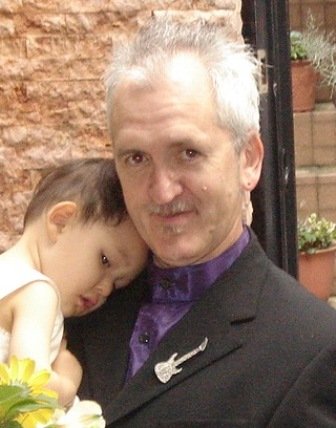
Fred Varcoe is a freelance journalist, loving father, useless husband and desperate golfer who plays his music LOUD!

He is the former sports editor at The Japan Times (fired), former editor of the Number 1 Shimbun (fired), two-time former secretary of the Foreign Correspondents’ Club of Japan (dumped) and currently contributing editor to Metropolis magazine.

Fred has written for dpa, Reuters, UPI, Billboard, Time Out, Virgin Atlantic’s Hot Air, Volleyball World, the International Volleyball Federation, Golf International, The Golf Times and a number of Japan-based publications. Many of his stories have been stolen and appeared in British newspapers and on websites under other people’s names.

He has done editing work for various publications and companies, including the Japan Football Association, Nissan, Metal One, Home and Away, Japan Railways and PanOrient News.

Fred has also written lyrics for musicians in Japan (Masahiro Motoki, Kyoji Yamamoto, Orange Kandy) and South Korea (Sinawe), served as an agent for British songwriter Warren Harry and helped with several music projects in Japan. His lyrics are actually really fucking good.

He was born in an area of Kent that has since been annexed by London and grew up in the English county of Monmouthshire, which has since been annexed by Wales. He is the founder and currently only member of the Monmouthshire Liberation Front.

He has lived in Occupied Kent, Occupied Monmouthshire, Hertfordshire, London, Saudi Arabia, Spain and Japan, and has spent far too much time (or perhaps not enough) in Thailand and South Korea.

He is married and has a daughter, who has already started to take over the world, so you’d better be nice to her (and to her father).

Fred plays all his music at Volume 11.