May 22 2011

Metallica live at Yoyogi Pool, Tokyo, 13 May, 1989
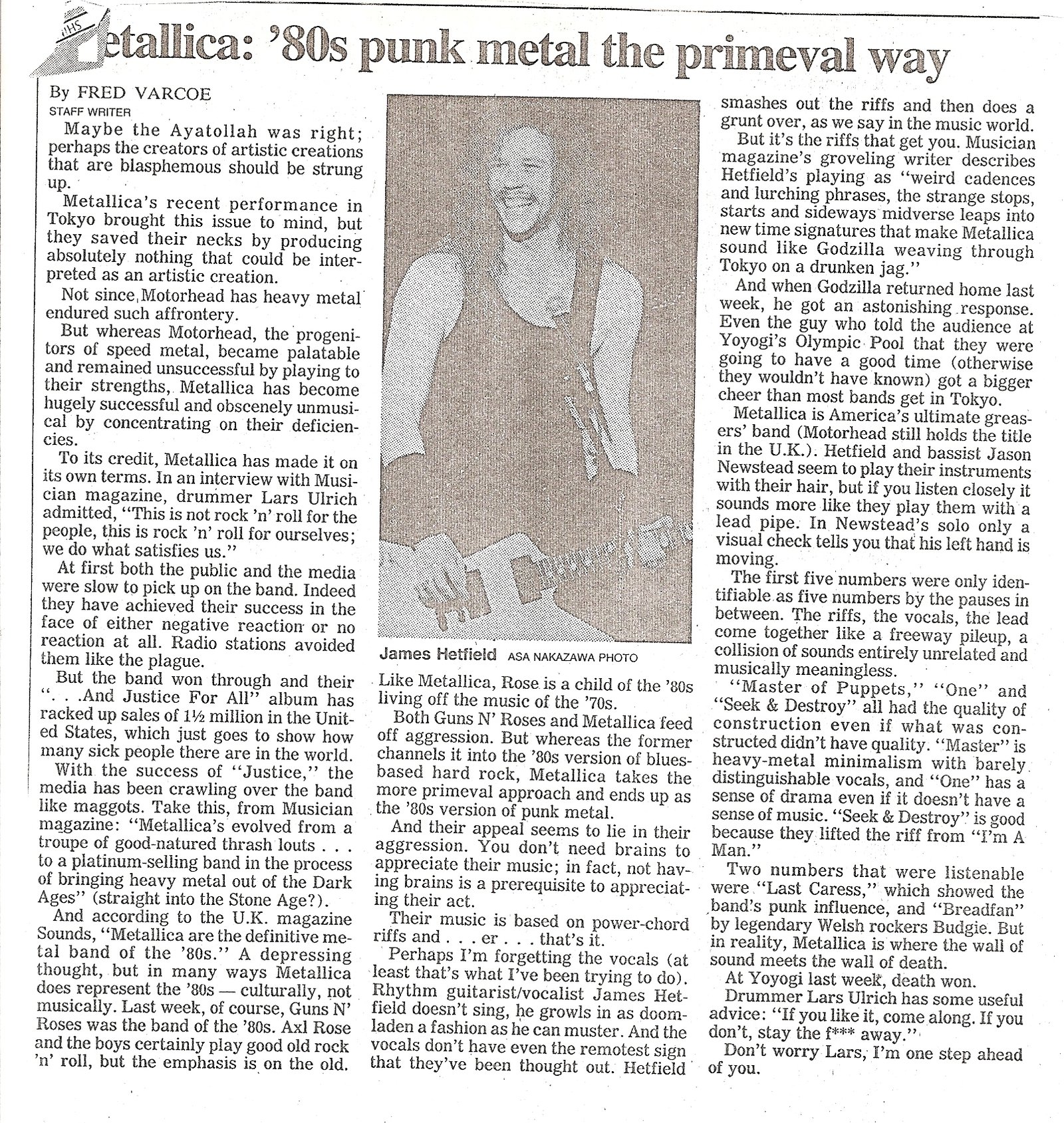

Metallica: ’80s punk metal the primeval way

By FRED VARCOE

Maybe the Ayatollah was right; perhaps the creators of artistic creations that are blasphemous should be strung up.
Metallica’s recent performance in Tokyo brought this issue to mind, but they saved their necks by producing absolutely, nothing that could be interpreted as an artistic creation.
Not since Motorhead has heavy metal endured such affrontery.
But whereas Motorhead, the progenitors of speed metal, became palatable and remained unsuccessful by playing to their strengths, Metallica have become hugely successful and obscenely unmusical by concentrating on their deficiencies.
To their credit, Metallica have made it on their own terms. In an interview with Musician magazine, drummer Lars Ulrich admitted, “This is not rock ‘n’ roll for the people; this is rock ‘n’ roll for ourselves. We do what satisfies us.”
At first, both the public and the media were slow to pick up on the band. Indeed, they have achieved their success in the face of either negative reaction or no reaction at all. Radio stations avoided them like the plague.
But the band won through and their ” … And Justice For All” album has racked up sales of 1 million in the United States, which just goes to show how many sick people there are in the world.
With, the success of “Justice,” the media have been crawling over the band like maggots. Take this, from Musician magazine: “Metallica’s evolved from a troupe of good-natured thrash louts … to a platinum-selling band in the process of bringing heavy metal out of the Dark Ages” (straight into the Stone Age?).
And according to the U.K. magazine Sounds, “Metallica are the definitive metal band of the ’80s.”
A depressing thought, but in many ways Metallica do represent the ’80s – culturally, not musically. Last week, of course, Guns N’ Roses were the band of the ’80s. Axl Rose and the boys certainly play good old rock ‘n’ roll, but the emphasis is on the old.
Like Metallica, Rose is a child of the ’80s living off the music of the ’70s.
Both Guns N’ Roses and Metallica feed off aggression. But whereas the former channels it into the ’80s version of blues-based hard rock, Metallica take the more primeval approach and end up as the ’80s version of punk metal.
And their appeal seems to lie in their aggression. You don’t need brains to appreciate their music; in fact, not having brains is a prerequisite to appreciating their act.
Their music is based on power-chord riffs and … er … that’s it.
Perhaps I’m forgetting the vocals (at least that’s what I’ve been trying to do). Rhythm guitarist/vocalist James Hetfield doesn’t sing, he growls in as doom-laden a fashion as he can muster. And the vocals don’t have even the remotest sign that they’ve been thought out. Hetfield smashes out the riffs and then does a grunt over, as we say in the music world.
But it’s the riffs that get you, Musician magazine’s grovelling writer describes Hetfield’s playing as “weird cadences and lurching phrases, the strange stops, starts and sideways mid-verse leaps into new time signatures that make Metallica sound like Godzilla weaving through Tokyo on a drunken jag.”
And when Godzilla returned home last week, he got an astonishing response. Even the guy who told the audience at Yoyogi’s Olympic Pool that they were going to have a good time (otherwise they wouldn’t have known) got a bigger cheer than most bands get in Tokyo.
Metallica is America’s ultimate greaser’s band (Motorhead still holds the title in the U.K.). Hetfield and bassist Jason Newstead seem to play their instruments with their hair, but if you listen closely it sounds more like they play them with a lead pipe. In Newstead’s solo, only a visual check tells you that his left hand is moving.
The first five numbers were only identifiable as five numbers by the pauses in between. The riffs, the vocals, the lead come together like a freeway pileup, a collision of sounds entirely unrelated and musically meaningless.
“Master of Puppets,” “One” and “Seek & Destroy” all had the quality of construction even if what was constructed didn’t have quality. “Master” is heavy-metal minimalism with barely distinguishable vocals, and “One” has a sense of drama even if it doesn’t have a sense of music. “Seek & Destroy” is good because they lifted the riff from “I’m A Man.”
Two numbers that were listenable were “Last Caress,” which showed the band’s punk influence, and “Breadfan” by legendary Welsh rockers Budgie. But in reality, Metallica is where the wall of sound meets the wall of death.
At Yoyogi last week, death won.
Drummer Lars Ulrich has some useful advice: “If you like it, come along. If you don’t, stay the f*** away.”
Don’t worry, Lars, I’m one step ahead of you.

(Originally published in The Japan Times)


May 14 2011

Sinawe

Korean rocker carries on the family business

By Fred Varcoe

Go to Korea and you feel like everyone’s got a chip on their shoulder. It’s like everyone wants to pick a fight with you. On this occasion, someone did.

I was just sitting at the bar drinking with Korea’s most famous rock band, Sinawe, and a few friends when this young salaryman started pointing in our direction and mumbling something about the “girl-like” longhairs in the bar. But like my friends, I tried to ignore him.

When he got up, I ignored him a little less, and when he knocked the barmaid flying into a glass table with a drunken lurch, I thought, “That’s . . .” I didn’t have time to think much more as the four members from Sinawe leapt on the guy, smashed their fists into his face, kicked him in the guts and finished him off by bringing a couple of chairs down on his head. Then we ordered another round of beers and resumed our conversation on whether or not Pearl Jam was mainstream or alternative.

If anyone in Korea has a right to be angry, Sinawe guitarist and leader Shin Dae Chul is well-qualified. At the age of 10, his life was turned upside down when his father, Shin Chung Hyan, was busted for drugs and sent to jail.

“When my father got busted, I felt betrayed by society,” the younger Shin said. “Even at the age of 10, I couldn’t believe people got put away just for smoking dope. Almost all the musicians around at the time smoked, but my father was the only one they crucified.

“It still bugs me.”

Just as Shin Chung Hyan was no ordinary musician, it was no ordinary bust. Shin Sr. was the very foundation of South Korean rock ‘n’ roll. But more than that, he was an integral part of the troubled social and political landscape in South Korea in the ’60s and ’70s.

After paying his dues playing for U.S. servicemen on military bases in Seoul, he went on to become South Korea’s top guitarist, composer and producer. Such was his popularity that President Park Chung Hee asked him to write a song for Korea. (“No deal” was the reply. Top marks for integrity, perhaps, but zip for political astuteness.)

In the late ’60s, Shin wanted to try and understand what was happening in the West. “I invited a lot of foreign hippies to my house after a concert in 1968,” he explained. “They smoked a lot of dope. I wanted to understand Jimi Hendrix — his music, his feelings, his image and his mood.” So Shin tuned in, turned on and dropped out.

“I woke up about a year later and got back to work,” he continued. “A few years later, some Korean musicians came to my house and were interested in finding out about marijuana. I didn’t really smoke any more, but I had a plant in the house and gave it to them.”

Bad move. One of them was an associate of President Park’s son, Park Chi Man. Eventually word got back to daddy and the defecation hit the oscillator.

A lot of musicians were arrested, but Shin took the rap and got thrown in jail for four months. At the time, Park was on the verge of a political crisis and since rock ‘n’ roll was a medium for unrest, it had to go. Shin’s music was banned completely in South Korea and when he came out of jail, he was basically a nonperson, shunned by his countrymen and divorced from his profession.

For five long years, Shin endured the pain of ostracism. Then, in October 1979, Park was assassinated. For Shin, down on his luck and running out of sanity, it was his moment of retribution, although he doesn’t look back in anger.

Although he never quite attained the musical heights he had reached previously, Shin’s exile did have one positive result — he could spend more time with his family.

Dae Chul learned well from his father and like a good Korean eldest son, he took over the family business. As his father was the prime mover in the first wave of Korean rock, so Shin Jr. became the prime mover in the second wave.

In 1986, when he was just out of high school, his band, Sinawe, released its first album. In a land dominated by disco in the first half of the ’80s, Sinawe’s brooding, if rough-edged, metal ripped across the musical landscape. It sold 400,000 copies and spawned a host of imitators. At 18, Shin Jr. became the focus of South Korea’s rock scene.

Although rock has been overtaken by dance music in the popularity stakes, Sinawe and Shin Dae Chul continue to maintain their position as prime movers in the heavier side of the Korean music scene.

That can be seen in some of Shin’s lyrics. Thirteen years on from his debut album, Shin has abandoned the rather predictable ’80s metal of his formative years and is now exploring the grungier, darker side of life and music.

The gravel-edged vocals blend in with a meaty rhythm section and Shin’s dominant guitar, the music reflecting the gloom that seems part of the Korean national psyche.

Shin himself leads the band from a position of strength. He handles most of the music and most of the business.

With his latest album, “Psychedelos,” Shin has taken a step back from the Kurt Cobain-like primitiveness of his previous two albums and tried to blend a few more melodies in with the mayhem. There’s no less power, but it’s less abrasive.

After jamming with Sheena and the Rockets a few months ago, Shin has now opted to bring the whole band over for a couple of live dates in Tokyo. More than a few curious Japanese rock stars are expected to turn up to see what the Koreans already know: Whether he’s swinging a chair or an ax, Shin Dae Chul will knock you out.

(Originally published in The Japan Times)